Author

Monica Cid
Mónica Cid is a Product Marketing Engineer at NXP, helping developers innovate with the FRDM ecosystem, MCX microcontrollers, and edge computing technologies.
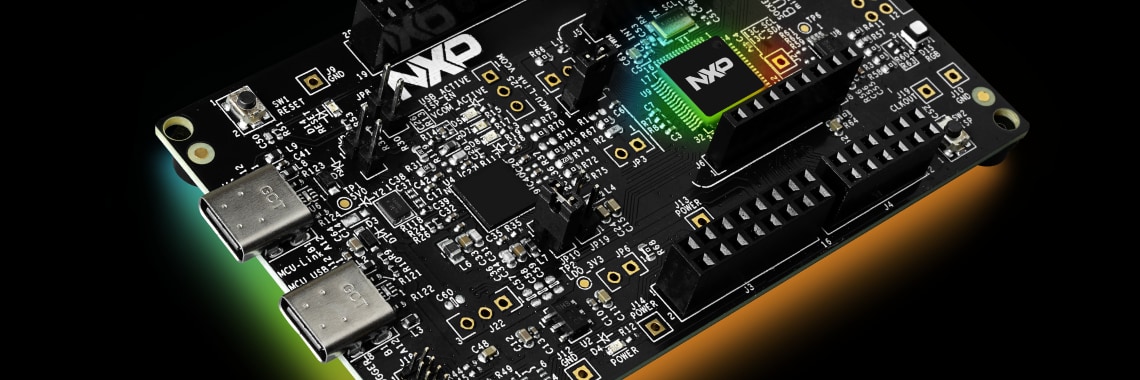
Today's engineering is often about making small decisions that add up to efficiency: reducing power, removing unnecessary parts, choosing cost-effective materials and designing energy-conserving systems that "sleep".
This same approach is now part of the FRDM-MCXC162 out-of-box experience.
With this launch, NXP is introducing a more responsible packaging approach while also highlighting what the MCX C Series does well—enabling low-power, cost-sensitive embedded applications that are practical for real-world designs.
The FRDM-MCXC162 is the first FRDM platform to use Forest Stewardship Council (FSC®)-certified paper packaging, sourced from sustainably managed forests. The FSC logo on the box indicates that the packaging materials come from controlled and responsible sources.
The packaging also uses paper-based structures, such as honeycomb and kraft paper, sourced to help protect the board while reducing consumption of less sustainable materials. With a goal to use materials that both reduce waste and provide sound protection in shipping, the packaging was tested for strength, durability and humidity-resistance.
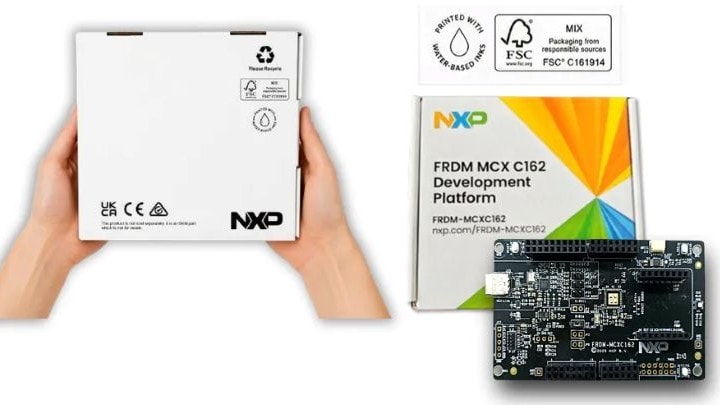
Another meaningful change in the effort to reduce waste is the removal of the USB cable from the standard pack-out. Knowing that many engineers already have USB cables on hand—on desks, in labs or inside debug kits—including yet another one in every box can only add to the surplus that goes unused.
Removing the USB cable eliminates approximately 50 grams of material, including copper, aluminum and plastic, from each unit. It also cuts around 0.12 kg of CO₂e emissions from manufacturing and raw material extraction, while reducing the chance of unused cables becoming e-waste.
It is a small change with a big impact when implemented across a portfolio.
The sustainability story goes beyond packaging. It continues with what low-power designs engineers can develop using the board.
The MCX C Series is designed for embedded applications where cost, efficiency and power consumption matter. The FRDM-MCXC162 launch demos show this through practical low-power sensing examples.
In the temperature sensing demo , the board spends most of its time in low-power mode, demonstrating event-driven sensing and communication while minimizing power consumption. It wakes on demand through a button press, reads data from the on-board P3T1755 temperature sensor and sends the result to a laptop over universal asynchronous receiver/transmitter (UART) for display in a terminal window.
Similar to the temperature sensor, the presence sensing demo defaults to low-power mode, but periodically checks for activity using a presence sensor, waking when presence is detected to capture measurements and updating an OLED display.
Both demos follow a simple embedded design principle—let the system sleep whenever possible, then respond quickly when there is work to do.

The FRDM-MCXC162 is based on an MCX C15 and MCX C16 microcontroller (MCU) with an Arm® Cortex®-M23 running at 72 MHz and integrated low-power peripherals.
It is a strong fit for applications such as smart building sensors, security sensors, occupancy detection, environmental monitoring, smart appliances, building automation, industrial sensing and battery-powered devices.
The MCX C family also includes peripherals such as analog-to-digital converter (ADC), comparator, operational amplifier (OpAmp), timers and communication interfaces, giving engineers the building blocks needed for sensing and monitoring systems.
Explore FRDM-MCXC162 open source low-power demos in Application Code Hub (ACH).
FRDM-MCXC162 brings together two ideas engineers can appreciate: remove what is not needed and optimize functionality.
That means more responsible packaging, fewer redundant materials and low-power demos that equip developers to design energy-efficient applications that reduce packaging resource consumption.
From the box to the power modes, FRDM-MCXC162 shows how smarter design choices can reduce waste, lower energy consumption and create a better starting point for embedded innovation.
Mónica Cid is a Product Marketing Engineer at NXP, helping developers innovate with the FRDM ecosystem, MCX microcontrollers, and edge computing technologies.