- Smarter Worldブログ
- The Smart Glasses Experience: Building Conversational AI at the Edge
The Smart Glasses Experience: Building Conversational AI at the Edge

How voice processing, audio engineering and edge AI are helping developers create more natural wearable experiences.
For decades, accessing information involved looking at a screen, typing a search query, navigating an application or tapping through menus. Today, conversational AI is introducing a new interaction model, changing the way we interact with technology. Instead of searching for information through keystrokes, users can ask questions through speech. Instead of navigating interfaces, they can interact through natural conversations.
Smart glasses are one example of how this evolution is taking shape. By combining voice interfaces, edge AI and wearable computing, this wearable device offers developers an opportunity to rethink how people interact with technology making information more accessible while reducing reliance on traditional screens.
Creating these experiences, however, requires much more than connecting a microphone to a language model. Developers must address challenges spanning voice processing, audio engineering, AI, wireless connectivity and low-power system design to enable interactions that feel responsive and natural.
The New Engineering Challenges Smart Glasses Bring
Wearable devices introduce design constraints that differ significantly from the traditional embedded systems. Every millimeter of board space matters. So does every milliwatt of power. Microphones, speakers, processors, batteries, antennas and sensors all compete for space within a lightweight form factor designed to be worn comfortably throughout the day.

Meanwhile, consumer expectations continue to shift. For example, users expect voice interactions to respond quickly, understand speech in noisy environments and deliver clear audio, all while maintaining sufficient battery life to support everyday use on the go. Meeting these expectations requires developers to consider the system as a whole rather than individual technologies.
Watch The Sound of Smart Glasses: Bringing Voice AI into the Real World to explore what's behind conversational AI for smart glasses.
However, conversational AI is about more than AI inference. The overall experience depends on how well voice capture, audio processing, AI, wireless communication and playback work together as a complete system.
Great Conversations Built on Milliseconds
Human conversation patterns serve as the natural communication model for AI to emulate.
People naturally acknowledge one another through small verbal cues such as "yes," "right," or "I understand." These responses, often referred to as back-channeling, help conversations flow naturally.
Likewise, people frequently interrupt to clarify a point or ask a follow-up question. Supporting this behavior, known as “barge-in,” is a key component in creating conversational AI experiences that feel intuitive rather than transactional.
These interactions are also highly sensitive to latency. Every stage of the processing pipeline contributes to the overall response time, including microphone capture, audio processing (beamforming), AI inference, wireless communication and playback.
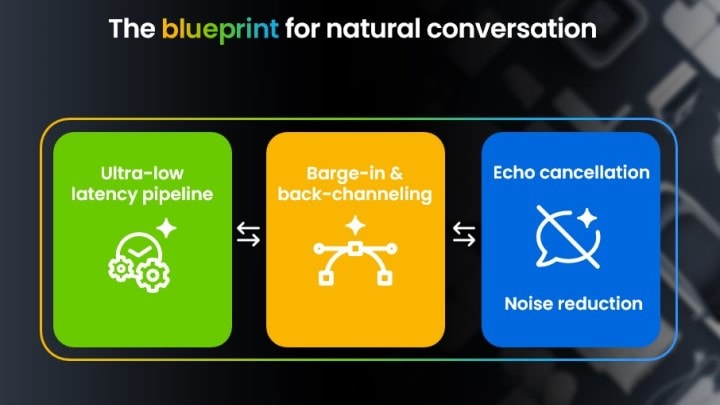
Although each stage may introduce only a small delay, the combined effect impacts how natural the interaction feels.
For developers, optimizing conversational AI means looking beyond individual algorithms and considering end-to-end system latency.
How Conversa Voice Suite Helps AI Hear in the Real World
Unlike controlled laboratory environments, smart glasses are designed to engage where people live and work—busy streets, in airports, at conferences, in offices and in manufacturing facilities. However, capturing the user’s speech accurately under these conditions presents a significant engineering challenge.
Beamforming enables microphone arrays to focus on a select sound source—such as the wearer's voice—while cutting out unwanted background noise. Adaptive beamforming extends this capability by dynamically adjusting to other voices to adapt to applications such as live translation or collaborative conversations.
Additional technologies—including echo cancellation and speech enhancement—help process audio before it reaches speech recognition engines, supporting reliable operation across a wide range of acoustic environments.
NXP's Conversa Voice Suite brings many of these capabilities together in a comprehensive voice processing software platform, facilitating hands-free communication. It includes technologies such as adaptive multi-microphone beamforming, acoustic echo cancellation and machine learning (ML) -based noise reduction, providing developers the software building blocks needed to create robust voice experiences for smart glasses and other voice-enabled edge devices.
Speech recognition performance depends on much more than the AI model itself. Microphone placement, beamforming, echo cancellation, noise reduction and system latency all contribute to the overall user experience.
Listening Is Only Half of the Conversation
Conversation is a two-way interaction, but capturing speech accurately is only one part of the experience. Delivering a clear, intelligible audio reply back to the user is equally important.
Producing consistent audio quality while minimizing distortion requires an intricate hardware design combined with advanced audio processing. Therefore, smart glasses rely on miniature speakers that operates within extremely tight mechanical constraints.
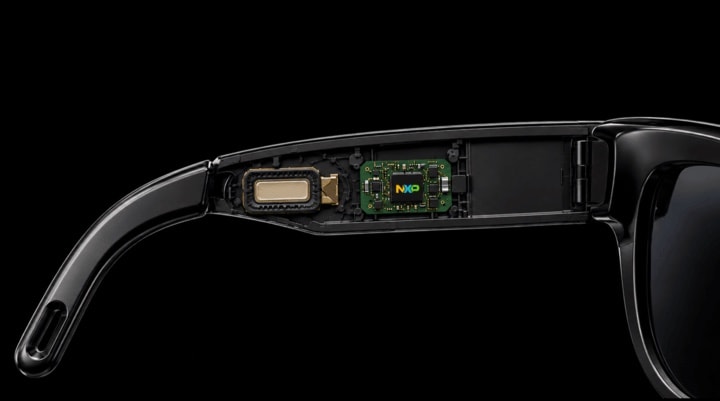
NXP's Essential Audio Processing (EAP) provides configurable audio processing algorithms designed to enhance playback quality in embedded systems. Capabilities such as speaker equalization, bass enhancement, loudness optimization and dynamic processing help developers tune audio performance for the unique constraints of compact wearable designs.
These considerations become increasingly important as conversational AI applications evolve beyond simple voice commands to support more continuous forms of interaction.
How Edge AI Supports Interactive Wearable Devices
Not every AI workload needs to run in the cloud. Instead, running portions of voice processing and AI inference at the edge can help reduce latency, improve responsiveness and minimize wireless bandwidth requirements. Local processing may also support applications where connectivity is intermittent or where developers choose to process select data on the device.
For wearable devices, efficient edge processing plays an important role in managing overall system power consumption.
The i.MX RT700 crossover MCU combines digital signal processor (DSP) capabilities, the eIQ® Neutron Neural Processing Unit (NPU) and low-power compute domains designed to support voice and audio workloads for always-on applications. When combined with software building blocks for beamforming, echo cancellation, speech enhancement and embedded audio processing, developers have available an integrated foundation for voice-enabled edge designs.
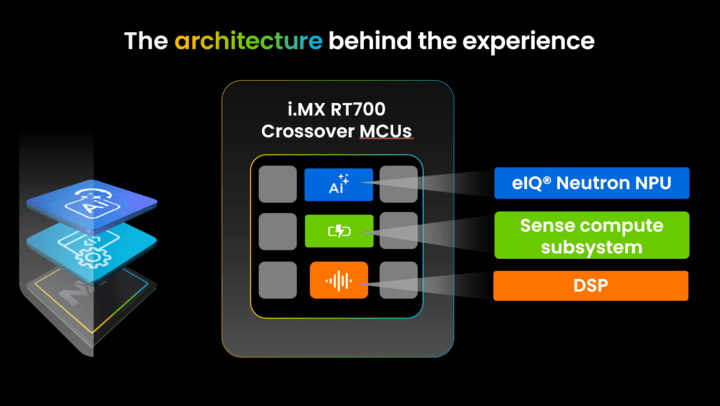
Rather than managing hardware and software challenges separately, developers increasingly benefit from platforms that allow them to optimize the complete conversational pipeline.
Conversational AI is a system-level challenge. Voice capture, audio processing, edge AI, software and hardware all work together to shape the overall user experience.
Tune in! EdgeVerse Techcast ft. Laurent Pilati on Apple Podcasts, Spotify or YouTube for more on conversational AI for smart glasses.
Industry Collaboration Accelerates Innovation in Conversational AI Experienced
Advancing conversational AI requires collaboration across the ecosystem. During the Augmented World Expo (AWE) keynote, NXP was joined on stage by Brian Vogelsang of Google to discuss how the companies are working together to support conversational AI experiences for Android XR.
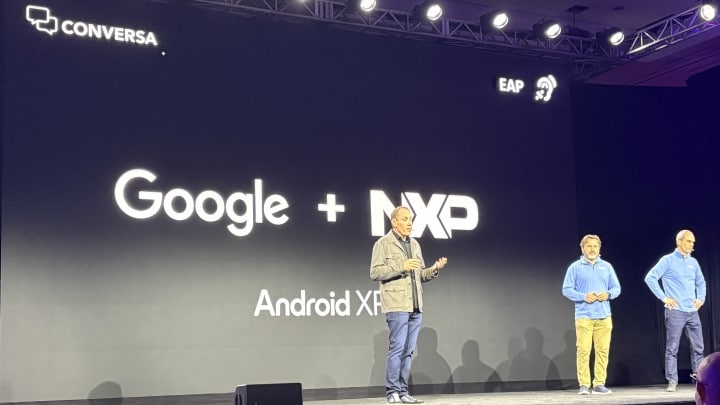
As part of the ongoing collaboration, NXP's Conversa Voice Suite and EAP Library were integrated to help enhance voice capture and audio playback. This demonstrates how software innovation and ecosystem partnerships can help accelerate the development of wearable AI experiences.
Looking Ahead with Smart Glasses
Smart glasses are helping shape new approaches to human-machine interaction (HMI).
As conversational AI continues to evolve, developers have an opportunity to design experiences that feel more natural, more responsive and better integrated into everyday activities. Achieving these goals requires balancing performance, latency, audio quality and power efficiency within a highly constrained wearable platform.
While smart glasses are a compelling use case, many of the same design principles apply to other voice-enabled edge devices, including industrial systems, healthcare equipment, consumer wearables, robotics and smart home products.
As these applications continue to evolve, success in this space will depend not only on advances in AI models, but also on a thoughtful system architecture that brings together voice processing, audio engineering and edge AI.
Getting Started with Voice AI at the Edge
Interested in exploring conversational AI for smart glasses or other voice-enabled emerging edge device technology? NXP offers a portfolio of hardware, software and development resources that can help accelerate your evaluation and design. Learn more about:
- i.MX RT700 crossover MCUs for low-power edge AI and advanced audio processing
- Voice and audio software technologies including beamforming, echo cancellation, speech enhancement and embedded audio processing
- Edge AI development resources for building intelligent voice-enabled applications
- The AWE keynote, The Sound of Smart Glasses: Bringing Voice AI into the Real World, for industry leader insights into the engineering considerations behind conversational AI in wearable devices
Whether you're building wearable devices, industrial systems or other intelligent edge applications, understanding the complete voice and audio pipeline is foundational for creating more natural AI experiences.
Authors

Laurent Pilati
Laurent Pilati is AI Software Engineering Manager at NXP Semiconductors, leading the development of AI software for MCU, MPU and NPU platforms. He specializes in embedded systems, edge AI, machine learning, wireless audio and signal processing, with extensive experience in voice, audio and intelligent edge applications. Laurent has also authored research publications and holds multiple patents in audio processing and communication systems.

Nik Jedrzejewski
Nik Jedrzejewski is Director of Wearables Business at NXP Semiconductors, leading the strategy for next-generation wearables, including smart glasses, hearables and smartwatches. With more than 25 years of semiconductor industry experience, he specializes in low-power solutions, edge AI, connectivity, voice and audio technologies. His background spans hardware and software development, product management, and wireless strategy across companies including Motorola, SigmaTel and AMD.