The advent of software-defined vehicles (SDVs) is expected to significantly
increase the volume of generated vehicle data, necessitating smarter data
forwarding from the vehicle. Data management solutions, like the one
offered by aicas, can assist OEMs and fleet operators in managing this data
effectively.
Enhancing Vehicle Telemetry and Signal Data Collection
Vehicle telemetry and signal data collection are crucial for regulatory
compliance. Beyond the vehicle data mandated and used during servicing,
additional signal values or data points can be recorded to enhance user
experience and to support development of new vehicle features of future
models. AI algorithms can also be employed to identify patterns or trends,
facilitating further improvements.
However, current data management approaches have limitations:
- Lack of a common taxonomy: There is no standardized naming
convention of signals
- Inconsistent sampling rates, units and signal representation:
These vary not only between OEMs but also across different platforms
- Proprietary solutions: Existing solutions are often proprietary
and not universally applicable
- High transmission costs: Despite the massive bandwidths offered by
LTE, 5G and other technologies, the associated cost of transmitting all
available signals would be enormous. Therefore, filtering and dynamic
selection of data are necessary
A collaborative solution involving OEMs, fleet operators and insurance
companies is required to address these challenges.
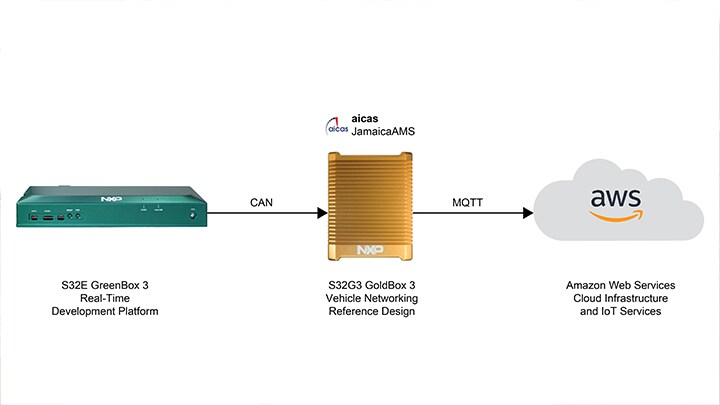 Vehicle Signal Specification (VSS) data management solution (aicas GmbH, 2024).
Aicas’s proposed solution incorporates the following components to address
some of the issues mentioned above:
- Common Vehicle Domain Taxonomy: Based on the open standard COVESA Vehicle Signal Specification (VSS)
- VSS is a catalog of signals related to vehicles
- VSS is a syntax for defining and organizing vehicle signals in a structured manner
For more details, see COVESA and GitHub pages.
- Normalization of signal data: The necessary (meta) information to normalize the signal data is part of the VSS signal specification for each vehicle model
- Flexible data selection: Scenario-based selection of data to be sent to the data center is available
- Graphical editor: To simplify the development of this collection scheme, a graphical editor that shows the data collection management of the target system as a flow is utilized
- Signal synthesis and mapping: The flexibility of this approach also allows us to synthesize signals from existing raw data or map additional, non-standard signals into the collection scheme
Drive the future of automotive innovation with NXP’s cutting-edge development platforms. Learn more about the capabilities of GreenBox 3 and GoldBox 3 platforms.
Details of the Solution
The software agent is implemented as a set of services running inside the
JamaicaAMS application management runtime system, a framework for
component-based applications.
With JamaicaAMS, embedded systems can be easily and flexibly updated and
reconfigured, remotely and at any time during runtime. The ability to reuse
components on various supported systems provides full scalability for
applications across fleets of vehicles. Within the JamaicaAMS component
system, the AWS FleetWise compatible data collection system is implemented
as a set of individual and independent software modules which communicate
asynchronously with each other via an internal message bus.
The three major components of this solution are:
- Signal conversion and normalization from the CAN bus
- Signal selection
- Signal transfer to the data center or cloud
System Demonstration on NXP Hardware
The system that allows real-time vehicle data access and management can be
seen in the figure below.
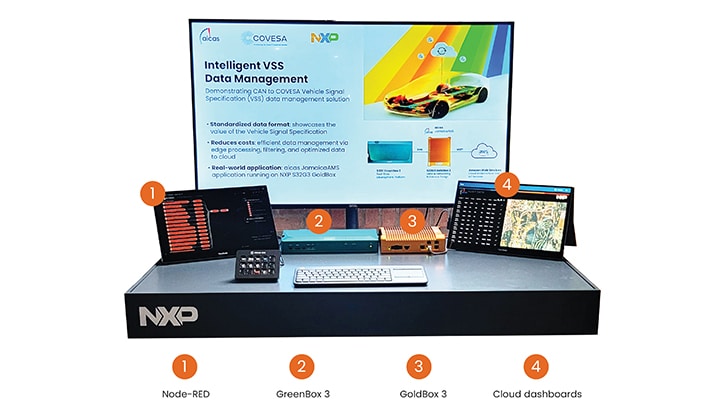 The demonstration system with NXP hardware and aicas software showcasing
VSS data management (NXP Semiconductors, 2024).
The demonstration system with NXP hardware and aicas software showcasing
VSS data management (NXP Semiconductors, 2024).
It comprises four main parts: NXP GreenBox 3 real-time development platform
(number 2 in figure), GoldBox 3 (3), Node-RED (1) and cloud dashboards (4).
The user can configure data selection flows related to vehicle dynamics,
battery management and energy management within Node-RED (screen marked 1)
and investigate the collected data on real-time cloud dashboards (4). The
low-code environment offered by Node-RED allows dynamic remote
reconfiguration on-the-fly for easy prototyping. A real vehicle system is
illustrated by the GreenBox 3 (CAN data source; number 1 in figure), and
the GoldBox 3 (CAN receiver and data processor; number 3 in figure)
combination from NXP, connected via a physical CAN bus.
Safe and secure S32G3 processors enhance vehicle networking and meet the
demands of next-generation vehicle architectures. Learn more about
S32G3.
With the CAN-to-VSS mapping and signal normalization, the ability of
defining signal collection schemes on these VSS signals, and the capability
to create vehicle models and group these into fleets, the aicas EdgeSuite
solution enables customers to quickly start with data collection and
management solutions without having to build systems from scratch. Their
embedded and cloud dashboards provide sophisticated data management for
fleet operators.
The solution can be deployed on NXP’s automotive processors. The NXP S32G3
vehicle network processor provides high-speed vehicle networking, POSIX
compute with Arm® Cortex®-A53 cores and ASIL D-capable computing using Arm
Cortex-M7 cores in lockstep.
Takeaways
The aicas and NXP collaboration leverages VSS through aicas EdgeSuite for
vehicle and fleet data management using NXP’s automotive processors: the
NXP S32G3 vehicle network processor and the NXP S32E2 real-time processor.
The integration of VSS provides several key benefits:
- Reduction of vehicle data fragmentation
- Easier integration of Tier-1 software and ECUs
- Collaboration with off-vehicle actors (e.g. charging stations)
Aicas EdgeSuite products enable customers to focus on rapid development of
data collection and management solutions without the need to create an
entire framework from scratch.
Discover more about this solution and it’s benefits by exploring our
dedicated
white paper.